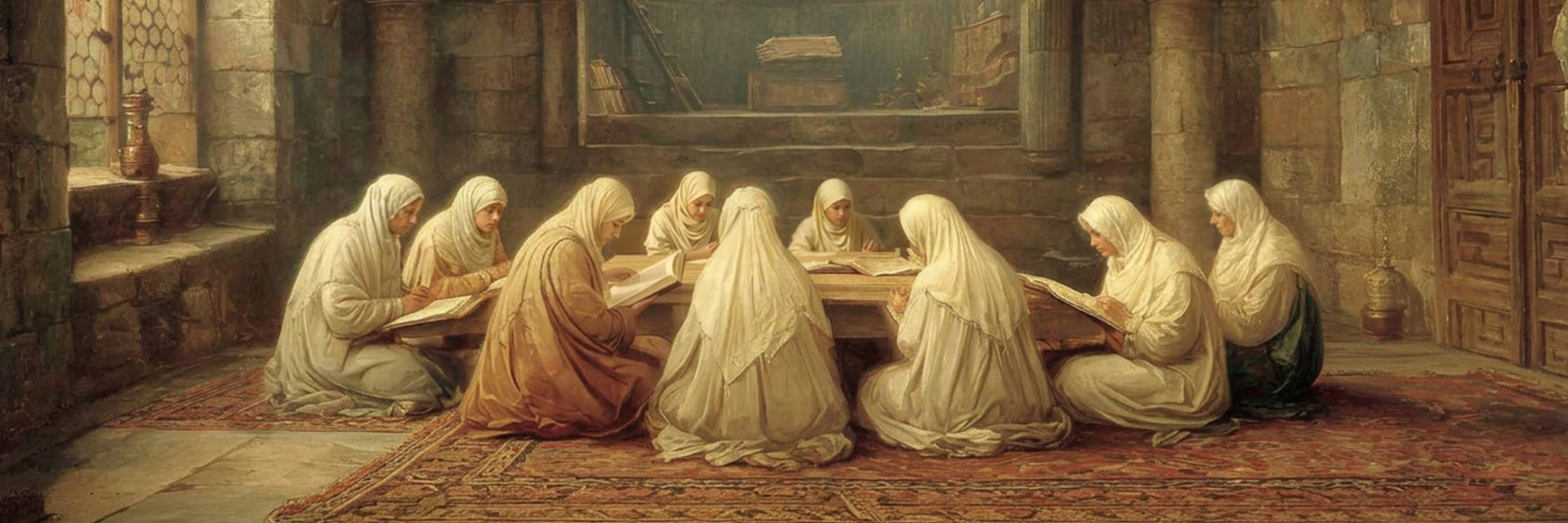
Ignaz Goldziher, the 19th-century orientalist who did more than almost anyone to shape how the West studies Islam, once paged through a 15th-century biographical dictionary and was “taken aback.” Not by anything scandalous — by the sheer number of women listed as authoritative transmitters of hadith.
That anecdote opens Jude Elziq’s new Yaqeen Institute paper, and it does real work: it’s evidence against the thing it’s describing. A scholar steeped in classical Islamic texts still found women’s scholarly presence surprising — which tells you the surprise was manufactured somewhere between the fifteenth century and the nineteenth, not present in the sources themselves. Elziq, a Cambridge PhD candidate in theology and religious studies, argues the classical biographical dictionaries — the genre Ibn Hajar al-Asqalani’s al-Durar al-kāmina belongs to — are dense with women appearing as routine links in isnad, the chains of transmission that anchor Islamic legal and prophetic knowledge. Not exceptional. Not symbolic. Routine: women teaching men and women alike, some holding ijazahs — formal teaching licenses — on a par with their male contemporaries, across the seventh to the fifteenth centuries.
The paper’s real argument isn’t “women did more than you think” — it’s diagnostic. Given that density of evidence sitting in the primary sources all along, why did popular memory of Islamic scholarship become almost entirely male? Elziq doesn’t hang the answer on one cause. She points to later historiography, print-era canon formation that selected which scholars got reproduced and taught, and orientalist framing — Goldziher’s own surprise being exhibit A of a Western scholarly gaze that expected the Islamic tradition to be patriarchal and found what it expected, passing over what didn’t fit.
What makes this land as more than one paper is that Yaqeen didn’t publish it in isolation — the same week’s newsletter built the same case from four other directions. Women in Islamic Law: Examining Five Prevalent Myths, by Dr. Nazir Khan, Tesneem Alkiek and Safiah Chowdhury, works the legal register — divorce, testimony, inheritance, polygamy, domestic abuse — clearing away readings that get attributed to “Islamic law” but don’t survive contact with the actual fiqh. “We Used to Have No Regard for Women”: Gender Equity & the Advent of Islam takes the founding moment itself, tracing ‘Umar ibn al-Khattab’s own account of how his view of women changed under the Prophet’s ﷺ guidance — a companion, not a modern apologist, naming the shift. Women in the Qur’an: Appreciating Female Faith, Wisdom, and Knowledge goes to the text itself, arguing the Qur’an engages women’s affairs in a female-centric register that later commentary didn’t always carry forward at the same intensity.
The podcast slate closes the loop from history into biography and apologetics. A Plea to Saintly Women: The Life and Legacy of Nana Asma’u profiles the 19th-century Sokoto scholar-poet — daughter of Usman dan Fodio, and herself a serious jurist and educator in West Africa’s Sahel — read through her own hagiographic poem for pious women. And Why Did Prophet Muhammad ﷺ Marry Aisha? Dismantling the Controversy of Aisha’s Age takes on what is probably the single most common polemical attack levelled at the Prophet ﷺ in interfaith and orientalist critique, working directly from the hadith record rather than around it.
None of these pieces argue with each other — Yaqeen isn’t staging a debate here, it’s building a case with five witnesses. Read as a set rather than five separate newsletter items, the argument gets harder to dismiss than any single paper would on its own: the erasure of women from Islamic scholarly memory wasn’t sitting in the sources. It was done to them afterward.
Also from this week’s feed:
- In Hardship and in Ease: How to Rely on God — Yaqeen Institute
- Falsafa, Tajdīd, and the Primacy of the Ethical — Hashiya